


SANTA MUERTE
Built from field recordings made during a residency at Casa Vecina, Fundación Carlos Slim, in 2015. 3D sound adapted for theGATE 2026.
Format
3D Audio Piece
Date
18. – 19.05.2026
Location
HLRS | Stuttgart
Only available on Monday and Tuesday
by MAURICIO VALDÉS SAN EMETERIO
The project
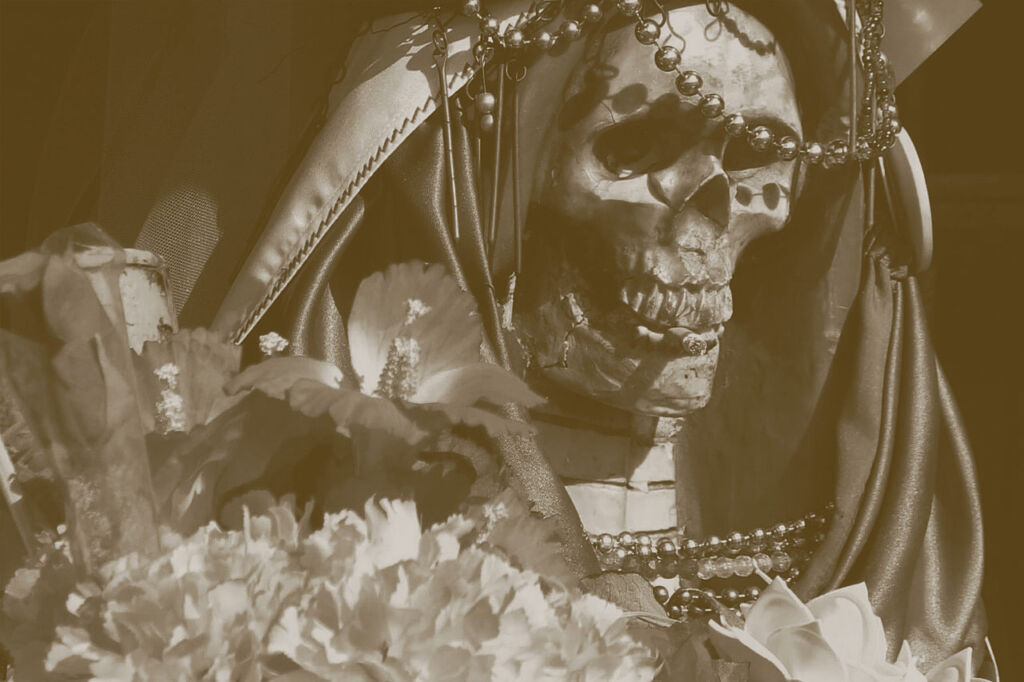
A few blocks separate two cathedrals in the historic center of Mexico City: Saint Michael Archangel, its atrium filling each Sunday with a brass band and the smell of copal; and the Lebanese Maronite Cathedral, where the liturgy is sung in Aramaic, the language of Christ's own prayers. A few streets further, in the working-class neighborhood of Tepito, devotees gather for the Rosario Viviente a la Santa Muerte — the Living Rosary — hands clasped before a skeletal figure draped in the colors of the Virgin.
This piece inhabits that triangle.
Santa Muerte is built from field recordings made during a residency at Casa Vecina, Fundación Carlos Slim, in 2015, in close collaboration with artist Miguel Mesa, whose recordings are woven throughout the work. The dramatic arc is cinematic: a Catholic Mass erupts into the noise of the city; a procession moves through the streets; the Aramaic chant of the Maronite rite folds into the crowd's devotion for a saint the official Church refuses to recognize. The space of the city — its chaos, its echo, its layers of faith — becomes the compositional material.
Santa Muerte is the outcast of Mexican religiosity and, in that sense, a near-perfect metaphor for acousmatic music itself. Both belong to the same lineage — one to Catholicism, the other to the Western concert tradition — and both are treated by their parent institutions as aberrant, undisciplined, too street-level to be taken seriously. Santa Muerte draws together pre-Hispanic iconography, Catholic ritual, and a fierce sense of collective belonging into a coherent cosmology that needs no institutional approval to function. Acousmatic music does something analogous: it composes with sound in space and time, extends Cage's re-definition of music to its logical conclusion, and finds most of its audience among the misfits who never felt at home in the concert hall to begin with.
The piece is structured around space as a narrative voice. Sound does not merely illustrate — it locates. The listener is placed inside a moving geography: inside the nave, on the street corner, in the middle of the rosary. At theGATE Festival, the work is diffused through an experimental speaker system directed toward the architecture of the room, using the surfaces of HLRS's space as an acoustic instrument. The piece does not reproduce the city; it lets the city pass through the room.
The artist
Media artist/composer and Head of R&D at Heka Art and Science Lab—expert in immersive audio technologies and computer-assisted sound creation.